Indian Motorcycle Girder Fork: the technical legacy and new concept unveiled at EICMA 2025
For many passionate riders, the mechanical details inside a motorcycle—how it’s built, how it reacts, how the suspension breathes—matter just as much as horsepower or branding. Within that realm, the girder-fork front suspension on Indian Motorcycle holds a special place. It’s a chapter of engineering that speaks of bold choices, heritage and evolution. And now, with a fresh concept revealed at EICMA 2025, that story enters a new phase.
In the early decades of motorcycling, front suspension was far from standardized. Manufacturers explored varied solutions—leaf-springs, trailing links, leading links, and girders. The girder fork, defined by its paired parallelogram arms and spring mechanism, provided rigidity and simplicity suited to the rough roads of its era. Indian’s use of the girder fork marks an important part of its engineering identity: a willingness to deviate from convention in pursuit of durability and control.
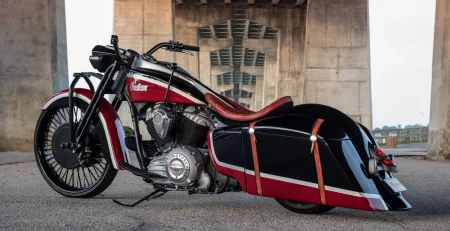
Indian Motorcycle’s adoption of the girder fork shows up in its mid-20th-century cruiser lineage. For example, after the Second World War, certain Chief models featured girder-type front ends, a move aimed at improving front-end stability under load and enhancing the riding feel in heavy-duty touring use. That experience carried into military applications such as the Indian 841 during World War II—a machine built for desert use with the kind of robustness the girder design could support.
But the story doesn’t end in the past. At EICMA 2025, Indian Motorcycle pulled back the curtain on a brand-new “Girder Concept” prototype. Though details remain partly under wraps, the concept revives the visual cues of the classic girder fork—exposed arms, architectural suspension look, a nod to heritage—but integrates it with modern technology: lightweight materials, refined linkages, maybe even adaptive damping. This move signals that Indian is not simply looking backward; it’s using its past as a springboard to re-imagine what a premium front end might look like in a high-end future model.
This unveiling at Milan transforms the girder-fork story into something current and relevant. It frames that suspension design not just as a vintage quirk but as a design language the brand may use to make a statement: heritage, innovation and identity in one. For riders, seeing the girder-fork geometry re-imagined suggests that Indian values its roots but refuses to remain static.
From a rider’s standpoint, the difference in feel between a girder fork and a telescopic fork is subtle yet profound. The visual geometry you see—arms, pivots, springs—is a physical connection to the machine’s motion. It doesn’t hide the mechanism. You sense the front end pivot under braking or leaning. In contrast, modern telescopic forks hide much of that architectural structure. When a brand like Indian brings back the girder look, it reminds the rider of the mechanical link between man and machine. And when that design meets modern materials, precise damping and electronics, the promise is appealing: vintage character with contemporary substance.
Of course, there are trade-offs. Girder forks historically carried more moving parts, required careful alignment and traveling less smoothly than modern telescopes in some usages. But in the context of Indian’s premium segment, where riders value craftsmanship, heritage and statement engineering as much as outright performance, those drawbacks become part of the charm.
Moreover, the unveiling of the concept at EICMA is a message: Indian Motorcycle isn’t simply updating its cruiser line. It’s exploring how identity, engineering and nostalgia can converge into something that appeals to discerning riders. It invites the question: could we see a production model using a modern girder system? If so, it might belong to the top-tier collection—perhaps a special edition, maybe a future high-end cruiser with a distinct look and advanced front suspension.
This moment also connects the past to the present. From the original use of girder forks in heavy-duty and military bikes, to their aesthetic in vintage Indian motorcycles, to this concept displayed in Milan, the narrative moves in a loop: design has consequences, riders feel them, and brands who harness those sensations build loyalty. For motorcyclists who appreciate authenticity, material detail and a story under the surface, the Indian girder-fork concept means something more than an engineering footnote—it means identity.
Ultimately, when you ride any Indian Motorcycle—or simply admire one in the showroom—you are part of a legacy. The girder-fork chapter is a reminder that the brand once made bold choices, faced the road’s challenges head-on, and built machines with soul. The concept at EICMA 2025 suggests that legacy remains alive, not locked in the past but evolving into what might be the next generation of premium riding.